
Muslims often say that Muhammad was so honest that even people who didn’t believe in Islam called him “Al-Amin,” which means “the trustworthy one.” They trusted him with their things before he became a prophet. But when we look at Islamic books, we see something different. At the Battle of Badr, which was a big win for early Muslims, some of Muhammad’s closest friends accused him of taking a piece of red cloth from the war prizes. These friends were special—they fought at Badr, and Islamic sources say Allah promised them paradise while they were still alive.
Think about it, Muslims: If Muhammad was truly the most honest person, why would his best followers, who risked their lives for him, think he might steal something small like a cloth? Doesn’t that make you question the stories about his perfect character?
The Quran talks about this in Surah Al-Imran, verse 3:161. This verse came down because of the accusation. Let’s look at the references one by one. I’ll show the book name, the exact part, the Arabic text (if there), the English translation, and Urdu if it’s available.
Reference 1: Quran, Surah Al-Imran, Ayah 3:161
- Book Name and Details: The Holy Quran, Chapter 3 (Al-Imran), Verse 161.
- Arabic Text: وَمَا كَانَ لِنَبِىٍّ أَن يَغُلَّ ۚ وَمَن يَغْلُلْ يَأْتِ بِمَا غَلَّ يَوْمَ ٱلْقِيَـٰمَةِ ۚ ثُمَّ تُوَفَّىٰ كُلُّ نَفْسٍۢ مَّا كَسَبَتْ وَهُمْ لَا يُظْلَمُونَ
- English Translation: It is not for a prophet to cheat (in war booty). Whoever cheats will come with what he cheated on the Day of Judgment. Then every person will get paid fully for what they did, and no one will be treated unfairly. (From Quran.com, translation by Dr. Mustafa Khattab)
This verse was revealed to defend Muhammad. Why would Allah need to send a verse if no one doubted him? Muslims, ask yourself: If the accusation was false, why didn’t Allah just say who the real thief was?
Reference 2: Asbab Al-Nuzul by Al-Wahidi, for Quran 3:161
- Book Name and Details: Asbab Al-Nuzul (Reasons of Revelation) by Al-Wahidi, Explanation for Surah 3, Ayah 161.
- Arabic Text: Not directly quoted in the source, but refers to the Quran verse above.
- English Translation: Ibn Abbas said: “Some red velvet acquired as booty from the idolaters at the Battle of Badr was unaccounted for, and some people said: ‘Perhaps it is the Prophet, Allah bless him and give him peace, who took it’. And so Allah, exalted is He, revealed (It is not for any prophet to embezzle (an yaghulla)).” (From Altafsir.com)
This book explains why the verse came down. It shows that even after a big victory, people whispered about Muhammad taking the red cloth. If he was Al-Amin, why the doubt from his own group?
Reference 3: Tafsir Ibn Kathir, for Quran 3:161
- Book Name and Details: Tafsir Ibn Kathir (Explanation of the Quran by Ibn Kathir), for Surah 3, Ayah 161.
- Arabic Text: Refers to the Quran verse: وَمَا كَانَ لِنَبِىٍّ أَن يَغُلَّ (It is not for any Prophet to illegally take a part of the booty).
- English Translation: This Ayah was revealed in connection with a red robe that was missing from the spoils of war of Badr. Some people said that the Messenger of Allah might have taken it. So Allah revealed: It is not for any Prophet to illegally take a part of the booty… and whosoever is deceitful with the booty, he shall bring forth on the Day of Resurrection that which he took. (From Quranx.com and Altafsir.com)
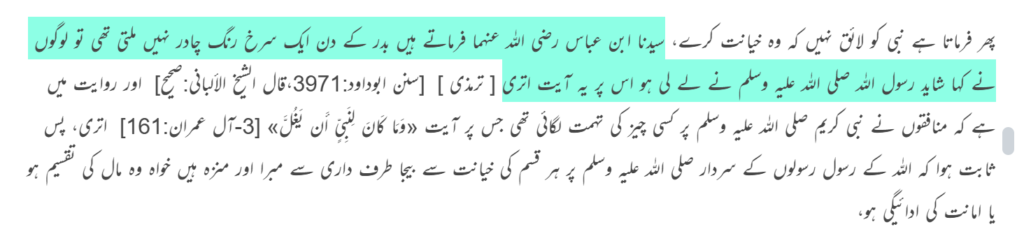
Ibn Kathir, a famous scholar, confirms the story. He says it was about a red robe at Badr. Muslims, if these were just “hypocrites” accusing him, why do the books say “some people” without naming them? Doesn’t it show real doubt among believers?
Reference 4: Sunan Abi Dawud, Hadith 3971
- Book Name and Details: Sunan Abi Dawud (Collection of Hadiths by Abi Dawud), Book 30 (Dialects and Readings of the Quran), Hadith Number 3971.
- Arabic Text: حَدَّثَنَا قُتَيْبَةُ بْنُ سَعِيدٍ، حَدَّثَنَا عَبْدُ الْوَاحِدِ بْنُ زِيَادٍ، حَدَّثَنَا خُصَيْفٌ، حَدَّثَنَا مِقْسَمٌ، مَوْلَى ابْنِ عَبَّاسٍ قَالَ قَالَ ابْنُ عَبَّاسٍ رضى الله عنهما نَزَلَتْ هَذِهِ الآيَةُ { وَمَا كَانَ لِنَبِيٍّ أَنْ يَغُلَّ } فِي قَطِيفَةٍ حَمْرَاءَ فُقِدَتْ يَوْمَ بَدْرٍ فَقَالَ بَعْضُ النَّاسِ لَعَلَّ رَسُولَ اللَّهِ صلى الله عليه وسلم أَخَذَهَا فَأَنْزَلَ اللَّهُ عَزَّ وَجَلَّ { وَمَا كَانَ لِنَبِيٍّ أَنْ يَغُلَّ } إِلَى آخِرِ الآيَةِ . قَالَ أَبُو دَاوُدَ يَغُلَّ مَفْتُوحَةُ الْيَاءِ .
- English Translation: Narrated Abdullah ibn Abbas: The verse “And no Prophet could (ever) be false to his trust” was revealed about a red velvet. When it was found missing on the day of Badr, some people said: Perhaps the Messenger of Allah has taken it. So Allah sent down “And no prophet could (ever) be false to his trust” to the end of the verse. (Grade: Sahih – Authentic) (From Sunnah.com)
- Urdu Translation: From the user’s image: پھر اس نے کہا کہ یہ وہ نہیں ہے جو ہم دے رہے ہیں اور رسول اللہ صلی اللہ علیہ وسلم نے فرمایا ہم تو اس لیے آئے ہیں کہ جو ہمارے پاس ہے دے دیں اور جو نہیں ہے نہ دیں۔ رسول اللہ صلی اللہ علیہ وسلم کی روایت میں ہے کہ بعض لوگوں نے کہا شاید یہ مال خادم نے چوری کیا ہے۔ (This is a part of the narration in Urdu about the incident.)
This hadith is graded as strong (Sahih). It comes from Ibn Abbas, a close relative of Muhammad. Why would “some people” – likely companions – say this if they fully trusted him?
Reference 5: Jami’ at-Tirmidhi, Hadith 3009
- Book Name and Details: Jami’ at-Tirmidhi (Collection by At-Tirmidhi), Chapters on Tafsir, Hadith Number 3009.
- Arabic Text: حَدَّثَنَا قُتَيْبَةُ، حَدَّثَنَا عَبْدُ الْوَاحِدِ بْنُ زِيَادٍ، عَنْ خُصَيْفٍ، حَدَّثَنَا مِقْسَمٌ، قَالَ قَالَ ابْنُ عَبَّاسٍ نَزَلَتْ هَذِهِ الآيَةُ : ( وَمَا كَانَ لِنَبِيٍّ أَنْ يَغُلَّ ) فِي قَطِيفَةٍ حَمْرَاءَ افْتُقِدَتْ يَوْمَ بَدْرٍ . فَقَالَ بَعْضُ النَّاسِ لَعَلَّ رَسُولَ اللَّهِ صلى الله عليه وسلم أَخَذَهَا فَأَنْزَلَ اللَّهُ كَانَ لِنَبِيٍّ أَنْ يَغُلَّ ) إِلَى آخِرِ الآيَةِ .
- English Translation: Narrated Ibn Abbas: This verse “It is not for a Prophet to illegally take a part of the booty…” was revealed about a red robe that was missing from the Day of Badr. Some people said: ‘Perhaps the Messenger of Allah took it.’ So Allah revealed the verse to the end. (Grade: Da’if – Weak, but still mentioned in sources) (From Sunnah.com)
Even a weak hadith repeats the same story. It shows the tale was known in early Islam.
Now, about the Badr companions being promised paradise: The Quran says in Surah At-Tawbah, Ayah 9:100 that the first emigrants and helpers (including Badr fighters) will get paradise. A hadith in Sahih Bukhari (Book 59, Hadith 319) says: “Allah looked at the people of Badr and said: Do whatever you like, for I have forgiven you.”
Muslims, these were the best companions, promised heaven. Yet they accused Muhammad? Logically, if trust was perfect, this wouldn’t happen. Maybe the stories of his honesty are overstated to make him look better. What do you think – does this challenge your faith, or can you explain why his friends doubted him?