
Have you ever stopped to think about how the Quran describes the beginning of human life? It claims to reveal divine truths about embryo development, but one big idea—the embryo turning into a “blood clot” (‘alaq in Arabic)—just doesn’t match modern science. This isn’t a small mistake; it’s mentioned in several verses and supported by hadith and old explanations (tafsirs). If the Quran comes from God, why does it sound so much like wrong ideas from ancient times? We’ll look at the texts themselves, add more proof from reliable sources, and ask some real questions. Let’s keep it fair: even ideas that might help defenders of the Quran will be included.
The Quran’s Main Idea: Humans Start as a “Blood Clot”
The Quran says people are created from ‘alaq (عَلَقٍ), which old sources say means a blood clot or thick blood. It starts in an early chapter:
Quran 96:2
Arabic: خَلَقَ الْإِنسَانَ مِنْ عَلَقٍ
English Translation: Created man from a blood clot.
This shows up in other places too, like a step-by-step guide: from a drop (nutfah), to a blood clot (‘alaqah), to a lump (mudghah), and more.
Quran 23:12-14
Arabic: وَلَقَدْ خَلَقْنَا الْإِنسَانَ مِن سُلَالَةٍ مِّن طِينٍ ثُمَّ جَعَلْنَاهُ نُطْفَةً فِي قَرَارٍ مَّكِينٍ ثُمَّ خَلَقْنَا النُّطْفَةَ عَلَقَةً فَخَلَقْنَا الْعَلَقَةَ مُضْغَةً فَخَلَقْنَا الْمُضْغَةَ عِظَامًا فَكَسَوْنَا الْعِظَامَ لَحْمًا ثُمَّ أَنشَأْنَاهُ خَلْقًا آخَرَ ۚ فَتَبَارَكَ اللَّهُ أَحْسَنُ الْخَالِقِينَ
English Translation: We created man from an extract of clay. Then We placed him as a sperm-drop in a firm lodging. Then We made the sperm-drop into a clinging clot, and We made the clot into a lump [of flesh], and We made [from] the lump, bones, and We covered the bones with flesh; then We developed him into another creation. So blessed is Allah, the best of creators.
More examples:
- Quran 22:5:
Arabic: يَا أَيُّهَا النَّاسُ إِن كُنتُمْ فِي رَيْبٍ مِّنَ الْبَعْثِ فَإِنَّا خَلَقْنَاكُم مِّن تُرَابٍ ثُمَّ مِن نُّطْفَةٍ ثُمَّ مِنْ عَلَقَةٍ…
English Translation: O people, if you are in doubt about the Resurrection, then [consider] that indeed, We created you from dust, then from a sperm-drop, then from a clinging clot… - Quran 40:67:
Arabic: هُوَ الَّذِي خَلَقَكُم مِّن تُرَابٍ ثُمَّ مِن نُّطْفَةٍ ثُمَّ مِنْ عَلَقَةٍ…
English Translation: It is He who created you from dust, then from a sperm-drop, then from a clinging clot… - Quran 75:38:
Arabic: ثُمَّ كَانَ عَلَقَةً فَخَلَقَ فَسَوَّىٰ
English Translation: Then he was a clinging clot, and [Allah] created [his form] and proportioned [him].
Why say this so many times? It seems to show God’s power through creation. But check any embryology book, like “Langman’s Medical Embryology” by T.W. Sadler or “Before We Are Born” by Keith L. Moore. There’s no “blood clot” stage. An embryo begins as a zygote (sperm + egg), becomes a blastocyst, implants, and grows tissues. Blood forms later, but it’s not a clot—it’s a structured tiny being. If this is from God, why the mismatch?
Muslim friends, if the Quran is perfect, why describe a key part of life wrong? Wouldn’t God use words that fit science forever?
What ‘Alaq Means: Not “Leech,” But Blood Clot
Some say ‘alaq means “leech” or “clinging.” Dictionaries like Almaany show “blood clot” first, “leech” second. But what do old tafsirs say? They pick blood clot.
- Tafsir Ibn Kathir on Quran 22:5:
Arabic: … ( ثم من نطفة ) أي : ثم جعل نسله من سلالة من ماء مهين ، ( ثم من علقة ثم من مضغة ) ذلك أنه إذا استقرت النطفة في رحم المرأة ، مكثت أربعين يوما كذلك ، يضاف إليه ما يجتمع إليها ، ثم تنقلب علقة حمراء
English Translation: …Then from a drop of fluid, then from a clinging blood clot… The nutfah stays in the womb for forty days… then it turns into a red blood clot (‘alaqah hamra). Now, let’s test “leech.” If ‘alaqah means leech, it becomes “turns into a red leech.” Does that make sense? Leeches are usually black or brown, not red. And why call an embryo a “red” leech? It sounds silly. But “red blood clot” fits—blood clots are red from fresh blood. This shows context points to clot, not leech. - Tafsir Al-Qurtubi on Quran 22:5:
Arabic: وقرأ الحسن بن أبي الحسن ( البعث ) بفتح العين ؛ وهي لغة في ( البعث ) عند البصريين . … ( ثم من علقة ) وهو الدم الجامد . والعلق الدم العبيط ، أي الطري . وقيل : الشديد الحمرة .
English Translation: Hassan bin Abi al-Hassan [Hassan Al-Basri] read… Then from a blood clot, which is coagulated blood. The blood clot is fresh blood, or very red.
Urdu Translation (from eQuranLibrary): اور پھر ہم نے نطفہ کو لوتھڑا بنایا (جسے علقہ کہتے ہیں اور وہ جما ہوا خون ہے) اور علقہ سے بوٹی بنائی… - Tafsir Jalalayn on Quran 96:2:
Arabic: خلق الإنسان الجنس من علق جمع علقة وهي القطعة اليسيرة من الدم الغليظ.
English Translation: Created man from a blood clot—‘alaq is the plural of ‘alaqah, a small quantity of congealing blood. - Majma’ al-Bayan fi Tafsir al-Quran (Shia Tafsir) on Quran 76:2:
Arabic: نطفة مشجت بدم الحيض فإذا حبلت ارتفع الحيض عن الحسن. وقيل: هي العروق التي تكون في النطفة عن ابن مسعود.
English Translation: A sperm mixed with menstrual blood, and when she became pregnant, her menstruation stopped.
Mind you, the mixing of semen with menses blood is not an agreed upon idea. It is widely debated in tafaseer. Some say, it is mixing of men’s water and women’s water and there any several different interpretations. Let’s not go into that.
These old sources—from Ibn Kathir, Al-Qurtubi (quoting Hassan Al-Basri), Jalalayn, and Shia ones—all say blood clot or congealed blood. No early ones say “leech” or “clinging mass”—that’s a new twist to fit science.
Question: If experts close to the Prophet’s time said blood clot, why change it? Doesn’t that mean the old meaning doesn’t work?
Hadith Add Details—with Wrong Timelines
Hadith explain more, like 40-day stages. Sahih first:
Sahih al-Bukhari 3208 (Sahih)
Arabic: إِنَّ أَحَدَكُمْ يُجْمَعُ خَلْقُهُ فِي بَطْنِ أُمِّهِ أَرْبَعِينَ يَوْمًا، ثُمَّ يَكُونُ عَلَقَةً مِثْلَ ذَلِكَ، ثُمَّ يَكُونُ مُضْغَةً مِثْلَ ذَلِكَ…
English Translation: Each of you is gathered in his mother’s womb for forty days, then becomes a blood clot for a like period, then a lump of flesh for a like period…
This hadith with similar wording is also mentioned in Sahih Muslim 2643a (Sahih), 40 Hadith an-Nawawi 4 (Sahih).
From Shia Source: Tafsir Burhan Volume 7 – Urdu Translation – Pg. 31-32
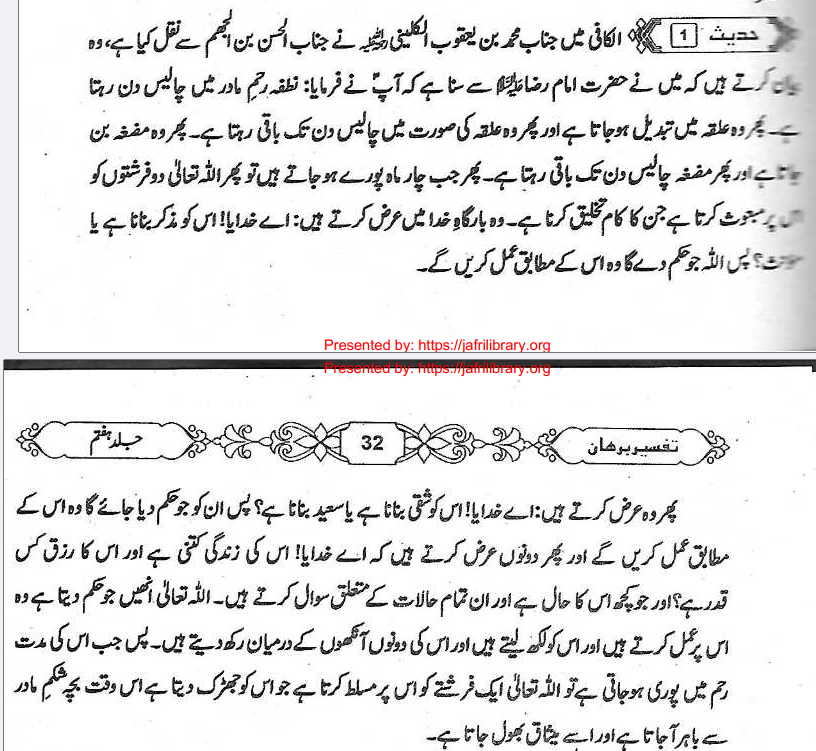
Al-Adab al-Mufrad 283 (Hassan per Albani)
Arabic: … إِنَّ النُّطْفَةَ لَتَسْتَقِرُّ فِي الرَّحِمِ أَرْبَعِينَ لَيْلَةً، ثُمَّ تَنْحَدِرُ دَمًا، ثُمَّ تَكُونُ عَلَقَةً، ثُمَّ تَكُونُ مُضْغَةً…
English Translation: The drop remains in the womb for forty nights and then the blood congeals and then it becomes a blood clot and then a lump of flesh…
From companion Abdullah bin Mas’ud. The word تَنْحَدِرُ دَمًا means “flows down as blood” or “becomes blood,” hinting at coagulation—like blood thickening.
Science: At 40 days, no clot—embryo has a heartbeat, arms, and more. No 40-day clot phase.
If from God, why wrong times?
The Source: Ancient Greek Ideas
This “clot” comes from Hippocrates, Aristotle, Galen. They said embryos start with “coagulation of the seed,” then parts form. Galen mentioned mixing seeds with menstrual blood.
From “The Oxford Handbook of Reproduction”: “Hippocrates, Aristotle, Galen… define three main stages: first the coagulation of the seed; then the formation of fetal parts…” DOI: 10.1093/oxfordhb/9780199781546.013.001
Muhammad’s area had Greek influence. Divine or borrowed?
Challenge: If Quran is timeless, why copy old errors? Why not real science like genes? Think about it—the facts should hold up.