
Islamic tradition strongly condemns the pre-Islamic practice of burying newborn girls alive (though this is largely an allegation within Islamic narratives with limited independent historical proof).
Yet the Hadiths deliver a shocking verdict on the victims:
They go to Hell:
Sunan Abi Dawud 4717 (Sahih per Al-Albani) “The woman who buries alive her new-born girl and the girl who is buried alive both will go to Hell.”
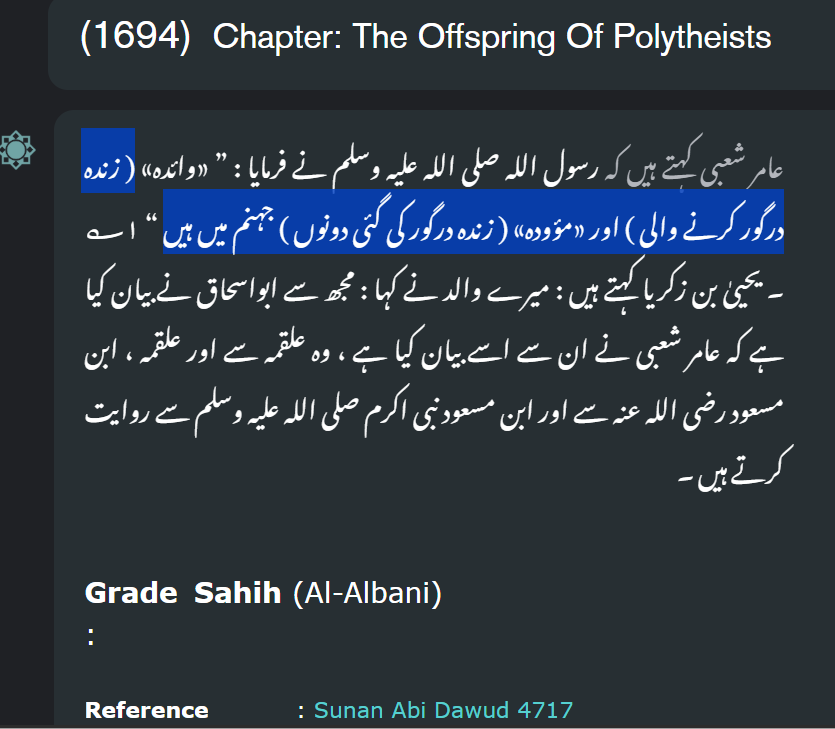
The same is repeated in:
Mishkat al-Masabih 112 (Sahih)
How is this justified? The innocent infant — a helpless victim murdered by her parents — is sent to eternal punishment alongside her killer. No mercy for the child who never lived long enough to sin or choose faith. This raises serious questions about divine justice and compassion. Why punish the victim of one of the most horrific crimes?
Then comes the twist:
Sunan Abi Dawud 2521 (Sahih per Al-Albani) A woman asked the Prophet (ﷺ): “Who are in Paradise?” He replied: “Prophets are in Paradise, martyrs are in Paradise, infants are in Paradise and children buried alive are in Paradise.”
Here the same murdered baby girls are granted Paradise.
This is a direct, irreconcilable contradiction on the same exact issue: the eternal fate of innocently murdered infants. Both sets of Hadiths are graded Sahih by Al-Albani.
Like many other topics in Islam (scientific claims, historical events, moral rulings, etc.), the sources clash with each other. One Hadith damns the victim to Hellfire. Another places her in Paradise with the prophets and martyrs.
Muslims, how do you reconcile this? If the most authentic collections disagree so fundamentally on something as important as who enters Hell or Heaven, what does this say about the claim of a perfectly preserved, error-free divine revelation?
The contradictions are plain to see in the books themselves.